

A browser engine for worlds worth sharing.
WebGPU rendering · Shared simulation · Visual world building
Get started · Explore the tools · Make a game · Hosting · Documentation
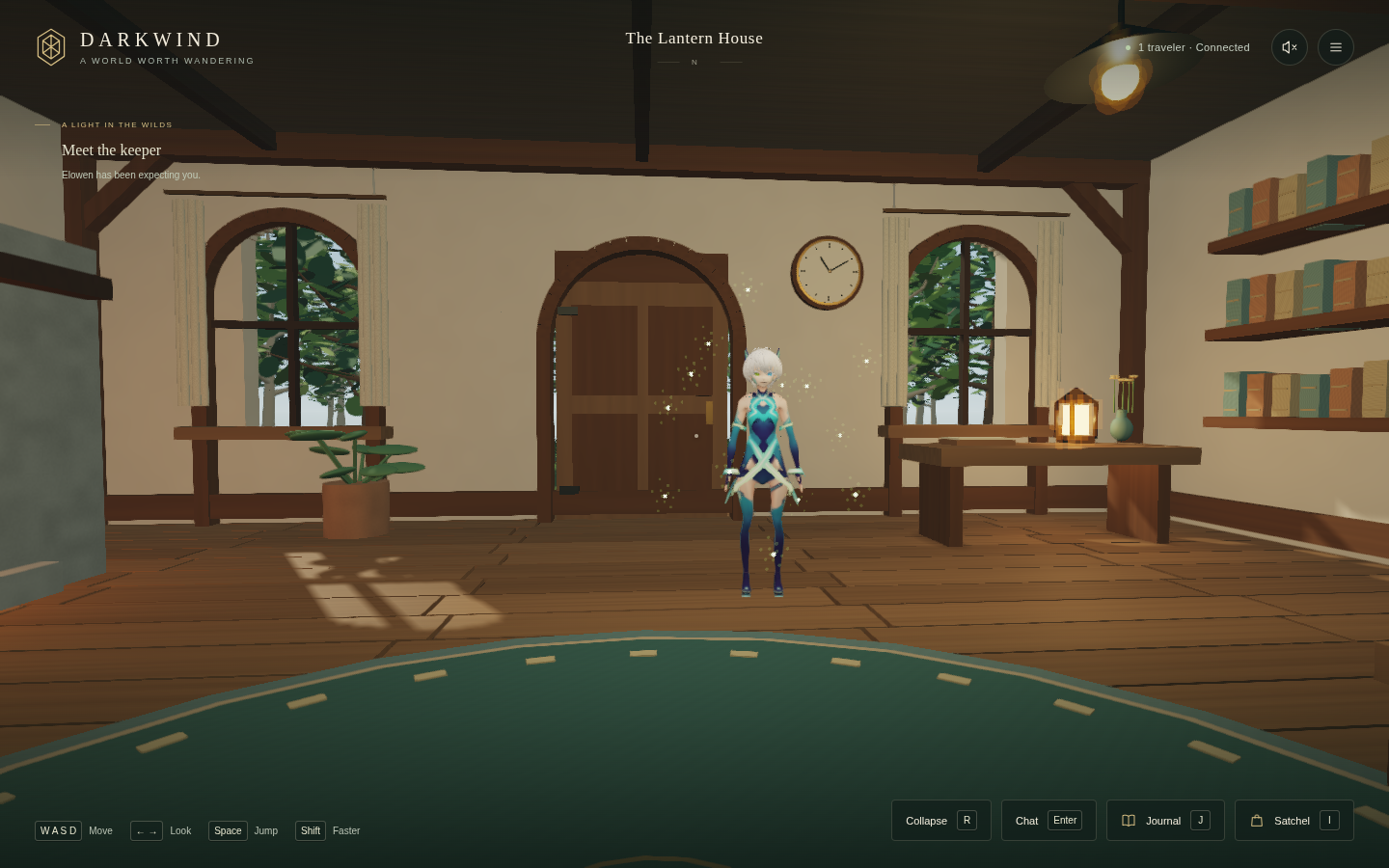
The Lantern House in Darkwind, the reference game built with Dusk. Actual in-engine capture.
Dusk brings a game engine, a world editor and multiplayer hosting into one project. Build a place, give it atmosphere and behavior, then open it in a browser and share it with someone else. The same rendering and content pipeline powers the editor, the player and published worlds.
The engine is independently implemented in TypeScript, with its own WebGPU renderer, simulation systems and content compiler. Games supply their own worlds, characters, controls, sound and story through explicit contracts. Dusk is the engine; Darkwind is its reference game.
#Get started
Use Node 22.23.4, pinned in .node-version, and a WebGPU-capable desktop browser with hardware acceleration enabled.
git clone https://github.com/jasona/dusk-engine.git
cd dusk-engine
npm ci
npm run dev:darkwind
Open localhost:5187 to enter Darkwind's current house-and-garden preview. Open the same URL in a second browser profile to meet another traveler in the shared room.
Walk with W A S D, look with the mouse or arrow keys, and press E to interact. Speak with the keeper, step into the garden, and take the two-seat cart for a ride together. Esc opens the menu; audio is opt-in. Full controls and game guide →
The launcher also prints a private editor link, including its access key.
Keep that link private. Leave the terminal running, and use Ctrl+C to stop.
The preview saves to .data/arrival-art.10, separately from other local rooms.
After updating source, stop the existing process before starting it again.
#What Dusk brings to a world
| Capabilities | |
|---|---|
| Light and atmosphere | WebGPU rendering, physically based materials, shadows, local lights, skies, particles and adaptive visual quality. |
| Places with life | Terrain, foliage, water, weather and day/night cycles, with imported GLB models and skeletal animation. |
| Things to do | Character movement, physics, vehicles, NPC navigation, gameplay resources, combat systems, behavior graphs and 2D tools. |
| People together | Multiplayer rooms, shared objects, chat, persistent state, portals and travel between hosted places. |
| A place to create | A browser editor with direct manipulation, asset import, reusable prefabs, collaborative previews, saved undo and playtest publishing. |
| A path to hosting | Validated content builds, retained engine versions, recovery systems, Docker profiles and optional PostgreSQL-backed services. |
These systems have different qualification limits. The capability matrix and release record describe their current scope and remaining checks.
#Explore the tools
Dusk World Atelier is a workspace for shaping and sharing a world. Select and transform objects, import models, arrange materials and light, author interactions, and save your draft. Start a shared development room to try changes together, or publish an invitation to a saved release.
npm run dev:editorOpen the private /editor.html#key=… link printed in the terminal. The default
atelier runs on port 5181; the Darkwind quick start above includes its own
atelier on 5187. Draft changes are saved separately from published worlds.
World Atelier guide →
Dusk Observatory is a window into the machinery: run a real rendering scene, inspect browser capabilities, compare main-thread and worker execution, exercise recovery, and export a diagnostic report.
npm run dev:clientOpen localhost:5173/diagnostics.html. This standalone diagnostics page does not need a multiplayer room. Rendering and measurement guide →
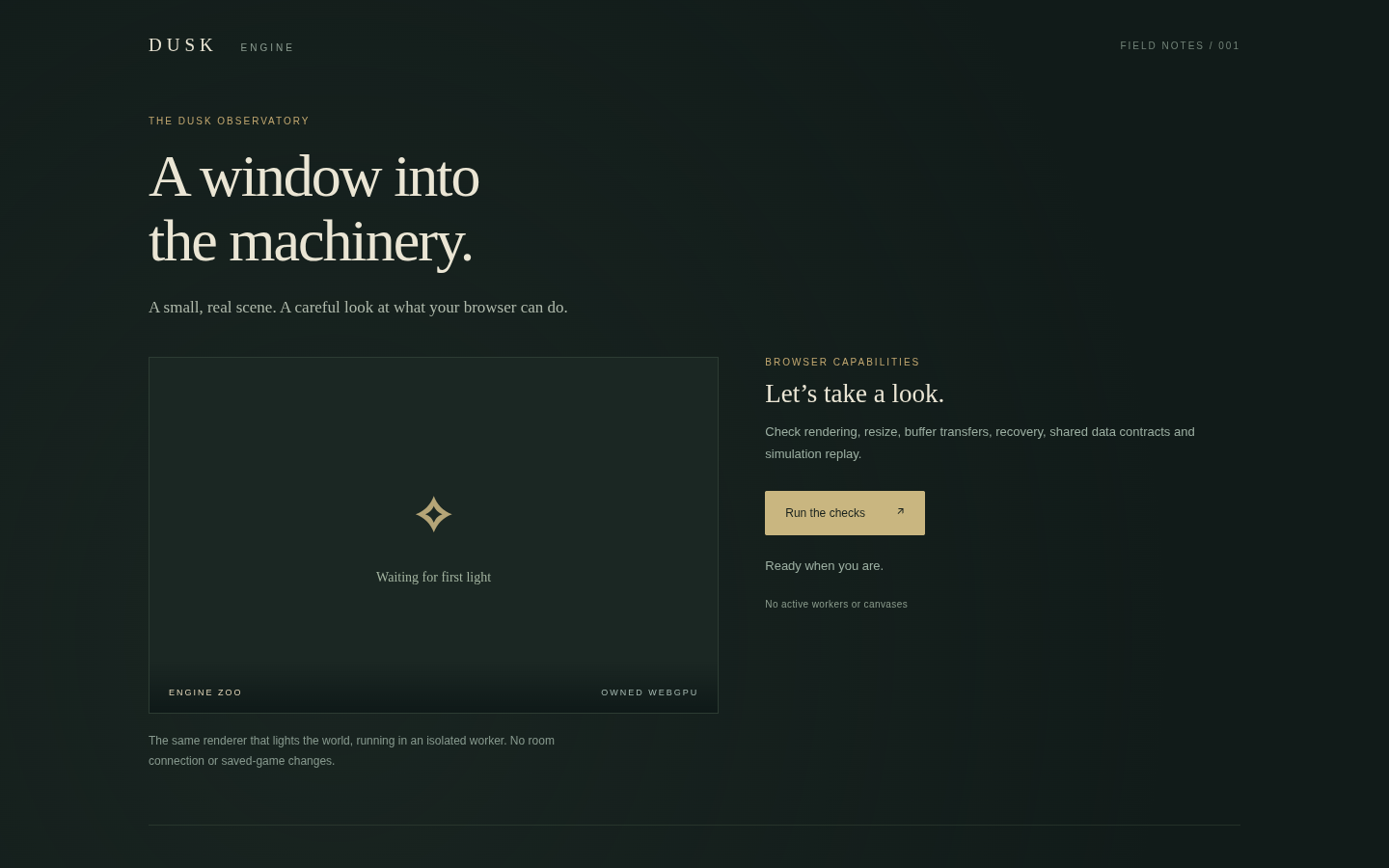
Dusk Physics Lab explores the engine's owned physics implementation in a dedicated browser lab.
npm run dev:physicsOpen localhost:5182/physics.html. Owned physics guide →
#Games made with Dusk
Darkwind · The First Light is the reference game: a cooperative journey
through the Lantern House, Rain Garden and Old Sanctuary. Its furnished arrival,
keeper, travelers and garden cart bring the engine's systems into a playable
world. Darkwind owns its art and story; its implementation lives in
games/darkwind/.
The Meridian is an independent cooperative puzzle built through the public SDK. Move the sunstone and moonstone, wake the observatory, and find the star terrace. It runs on the same player, editor and hosting services.
npm run dev:meridianOpen localhost:5188. The launcher prints a private
editor link and uses its own .data/meridian.1 room.
The Meridian and SDK guide →
More example worlds
These examples need PostgreSQL's initdb and pg_ctl on your PATH; their
launchers create separate local databases.
| Example | Run | Explore |
|---|---|---|
| The Lantern Trial | npm run dev:trial |
Shared resources, abilities and timed interactions. |
| The Sentinel Garden | npm run dev:sentinel |
A shared combat guardian. |
| The Watch Garden | npm run dev:watch |
NPC perception and navigation. |
| The Shared Lantern | npm run dev:extensions |
An installed creator extension. |
See the SDK guide for each world's URL, requirements and walkthrough.
#Make a game
Start visually in the World Atelier, or work in
TypeScript with the Dusk SDK. The SDK is currently a
source API in this repository. The Meridian's
game.ts is a complete example that imports
only the public entry point.
- Define a world. Create places, objects and interactions with stable identities.
- Give it a voice. An installed presentation adapter supplies the game's title, interface text, controls, traveler and sound.
- Build a release. Compile and validate content into a portable game document.
- Share it. Serve the release through Dusk's player and room services, or publish an invitation from the atelier.
Build the included SDK example and inspect the generated API reference:
npm run game:build -- games/cooperative-puzzle/game.ts /tmp/meridian-release.json
npm run sdk:reference
The build creates a new file and refuses to overwrite an existing release. Published invitations retain their exact engine build, so updating the engine preserves the runtime beneath an existing world.
SDK and presentation adapters → · Authoring and CLI → · Engine pinning →
#Hosting
To try the packaged default reference game locally:
npm run build
npm start
Open localhost:8787. This profile uses
.data/hearth, separately from the furnished arrival preview.
For Coolify, the repository includes Docker Compose profiles that build the
app, serve HTTP and WebSocket traffic on port 8787, and declare persistent
storage at /data. Use the Coolify guide for setup and the
current release handoff for the furnished arrival
profile. Public browser access needs HTTPS for WebGPU.
Configure the exact public origin with DUSK_ALLOWED_ORIGINS and a private room
passphrase with DUSK_ROOM_PASSWORD. Existing DW_ aliases remain supported;
conflicting values fail explicitly. Existing volume names and save identifiers
are preserved. Configuration and compatibility →
For PostgreSQL-backed worlds and larger hosting layouts, see persistent rooms and room routing.
#Inside the repository
| Location | Purpose |
|---|---|
packages/ |
Engine systems, SDK, renderer, simulation, physics and content contracts. |
apps/player/ |
The reusable browser player and game presentation boundary. |
apps/editor/ |
Dusk World Atelier. |
apps/probe/ |
Dusk Observatory and browser capability checks. |
services/ |
Multiplayer, persistence, authoring and hosting services. |
games/ |
Darkwind, The Meridian and independent example worlds. |
tools/ |
Build, import, authoring, benchmark and development tools. |
docs/ |
Technical guides, capability records and release notes. |
llm-docs/ |
Implementation plans for agent-assisted work. |
Engine packages never import games. The reusable player selects game presentation through one trusted installation registry, and the package boundary check enforces those relationships.
#Development and verification
npm run check       # Types, package boundaries and generated wire contracts
npm test            # Native test suite; some profiles require extra services
npm run build       # Production player, tools, server and retained engine
Browser checks, container checks and benchmarks
npx playwright install --with-deps chromium --only-shell
npm run test:browser
Browser checks build release assets and start an isolated room on port 5174;
they do not use your development room's saved data.
PLAYWRIGHT_EXECUTABLE_PATH can select an installed Chromium binary.
With Docker available, npm run test:container checks the production image.
npm run validate, npm run bench and npm run bench:storage provide additional
content validation and benchmark entry points. Software-rendered checks do not
measure hardware frame rates. See the release record
for pinned results and outstanding qualification work.
#Project status
Dusk is an early beta. The fixed 70-feature implementation inventory is complete, as is Darkwind's five-part visual polish pass. Those milestones are separate from production qualification: broader performance and device checks remain, and the pinned beta's Docker acceptance is still awaiting an external result. The release record is the source for tested commits and known limitations.
Darkwind's current shared-play target is two travelers on desktop WebGPU. An admission limit is not a measured player capacity; see room capacity before planning a larger deployment.
#Documentation
| If you want to… | Start here |
|---|---|
| Play the reference game | Darkwind guide |
| Build and publish a world | World Atelier · Authoring · Prefabs |
| Create a game in code | Dusk SDK · Components |
| Bring in models and materials | GLB import · Material graphs |
| Understand the engine | Architecture · Core contracts · Roadmap |
| Follow runtime state and recovery | Simulation time · Checkpoints · Presentation protocol |
| Deploy and operate | Coolify · Persistent rooms · Compatibility |
| See what is implemented and qualified | Capabilities · Progress · Release record |
Character source attribution and terms are recorded in art credits. Darkwind's art direction, actual screenshots and motion captures are collected in Traveler art.